
Organizing a webinar or participating in a trade show is a massive investment, both financially and in terms of human resources. Between booth rentals, collateral preparation, technical logistics, and expert mobilization, the bill adds up quickly. Yet, the success of these operations rests on a single, often stressful, performance indicator: attendance.
Too often, companies deploy incredible energy to create high-quality content but fail to attract the qualified audience necessary to make the operation profitable. Between newsletters that end up in the "Promotions" tab (or worse, in spam) and social media posts with a two-hour lifespan, capturing attention has become a daily battle.
Why "traditional" communication is no longer enough
To promote an event, the classic levers are known to everyone. While they remain necessary, they now present structural limits that you can no longer ignore:
- Mass Emailing: It’s the first instinct. You send an invitation to your entire database. The problem? Mass emailing is increasingly perceived as impersonal. With inbox saturation, the average B2B open rate rarely exceeds 20-25%. A large portion of your target audience won’t even see your message.
- Social Media: Essential for visibility, yet subject to the whims of algorithms. Unless you invest heavily in Ads, only a tiny fraction of your community sees your posts. Moreover, the audience is often "volatile": people "like," but they forget to register.
- The Website: This is your central pillar, but it is passive. For it to generate registrations, you first need to drive qualified traffic to it. If your prospect has no reason to visit your blog or homepage this week, they will miss your event announcement.
The solution is right before your eyes, in every interaction you have with your ecosystem: relational email. These messages that your teams send individually every day to your clients and prospects boast an open rate close to 100%. This is where the success of your event is determined—within this space of trust.
Why your signatures are your best marketing allies
For a trade show or a webinar, an email signature is not just an aesthetic detail or a legal obligation: it is a massive acquisition channel. It is one of the few advertising spaces that benefits from the recipient's total attention.
1. Multiplied reach (the power of volume)
The numbers speak for themselves. An employee sends an average of 35 emails per day. For a company of 20 people, that represents 700 daily opportunities, or 14,000 monthly opportunities to promote your booth or online conference. If you have 100 employees, we are talking about 70,000 impressions per month. What other channel offers such visibility without an additional advertising budget?
2. The "Growth Hack" of recommendation
This is the strongest psychological argument. People are much more likely to register for an event when the invitation comes from a trusted contact. When a sales representative discusses a project with a prospect, and the prospect sees a banner at the bottom of the email for a webinar specifically addressing their topic, the conversion is natural. This human interaction strengthens engagement well before the live event begins. You move from "cold" advertising to a "warm" recommendation.
3. Unbeatable ROI: Zero Cost-Per-Click
On LinkedIn or Google Ads, the cost-per-acquisition for a qualified B2B lead can skyrocket. With email signatures, you are using an existing flow. The marginal cost is zero. By using a solution like Signitic, you transform your fixed costs (your messaging tools) into a profit center.
4. Long-term capitalization (The Replay)
The event doesn't end when the curtain falls. The email signature allows you to capitalize on the post-event phase. With one click, you can transform your registration banner into a replay promotion banner. This extends the lifespan of your content and continues to generate qualified leads for months, with no extra effort.
2 events, 2 winning strategies with Signitic
The strength of a dynamic signature is its ability to adapt in real-time to your marketing calendar. Thanks to centralized management, Signitic allows you to deploy professional templates that respect your brand identity (logo, colors, typography) across all company workstations.
Strategy #1: For your Webinars (Creating urgency)
A webinar usually fills up within the 10 to 12 days preceding the live event. Your signature strategy should follow a temperature curve:
- Teasing Phase (D-21 to D-10): Install a sober banner that introduces the problem. The idea is to spark curiosity without necessarily pushing for immediate action.
- Conversion Phase (D-10 to D-3): The message becomes more direct. "Register now," "Discover our experts' advice."
- Urgency Phase (D-2 to D-Day): Switch to a "Last seats available" or "It’s tomorrow!" banner. The psychological aspect of scarcity significantly boosts the click-through rate.
The Signitic advantage: Once the webinar is over, you don't need to ask everyone to remove the banner. It updates automatically to offer the replay to latecomers.
Strategy #2: For your Trade Shows (Facilitating meetings)
At a trade show, success is not measured by the number of badges scanned on the fly, but by the quality of the exchanges. The hardest part is scheduling appointments in advance to avoid your experts standing idle at the booth.
- Intelligent Call-to-Action (CTA): Don’t settle for a passive message like "We will be there." Integrate a "Book a meeting at our booth" button linked directly to your calendar (such as Calendly or HubSpot). This transforms your signature into an automated appointment-setting tool.
- Surgical Precision: A major stress for trade show visitors is not being able to find the booth. Display your booth number and a quick access map directly in the banner. By removing these small logistical hurdles, you increase your chances of being visited.
The end of the marketing logistics headache
Before centralized management tools, the email signature was the "poor relation" of communication. You had to send an internal email to everyone with an image attached, hoping everyone installed it correctly. The result? Distorted banners, dead links, and a degraded brand image.
Uniformity & Segmentation
With Signitic, the major benefit is reactivity. 100% of your employees carry the right banner at the right time. But you can go even further with segmentation:
- Your Sales team promotes this week's professional trade show.
- Your Customer Success team highlights a training webinar for current clients.
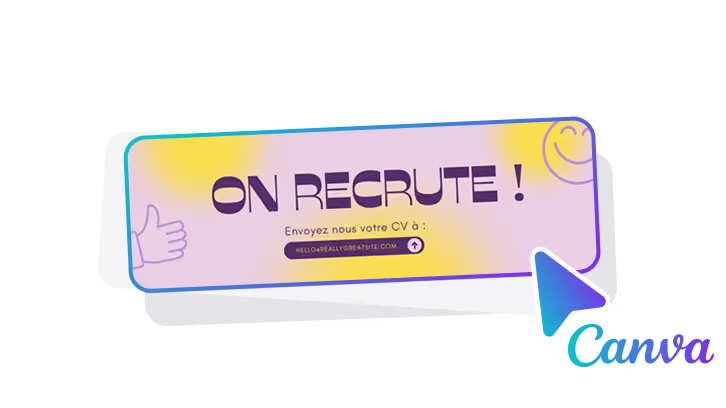
- Your HR team displays a banner for the local recruitment fair.
Every employee becomes a precise ambassador, delivering the right message to the right target.
Analysis and Performance
Managing your signatures requires technical rigor. Signitic does more than just "place images." The platform tracks key indicators for you:
- Click-Through Rate (CTR): Which banner is performing best?
- Impression Volume: How many times has your event been seen?
- Deliverability: Unlike a "home-made" HTML signature that could be blocked by spam filters, Signitic ensures perfect compatibility with Gmail, Outlook, and Apple Mail.
Conclusion: Transform your routine into a growth lever
Stop leaving the success of your events to algorithms or chance. By transforming your email signatures into dynamic advertising assets, you gain visibility that your competitors have yet to exploit.
An effective signature is one that attracts attention without being aggressive, conveys your expertise, and facilitates action (registration or appointment) at first glance. It is the simplest and most cost-effective way to fill your conference rooms and your booths.